Working paper
Perceived Unemployment Risks over the Business Cycle[Working Paper][Slides][Bib]
(with Xincheng Qiu, William Du and Adrian Monninger )Perceived versus Calibrated Income Risks in Heterogeneous-agent Consumption Models (Job Market Paper)[Working Paper][Bib]
(JPE Macro, Accepted)
Details
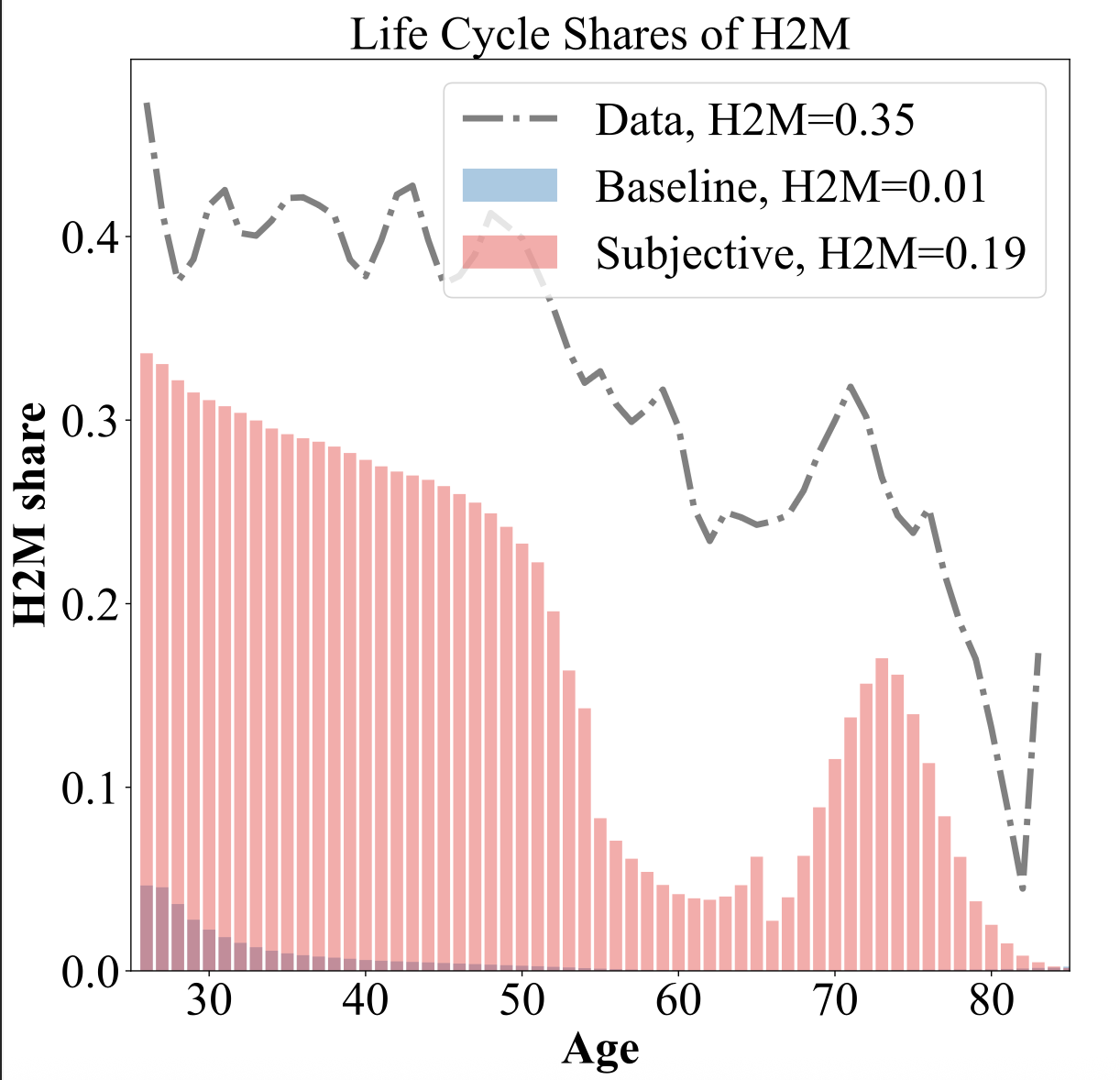
- Stylized facts on perceived income risks revealed in density surveys in comparison to the estimated income risks used in incomplete market macro models.
- An incomplete-market life-cycle model with subjective/heterogeneous income risks calibrated from the survey data.
- Heterogeneity in income risks as a new observable factor accounting for wealth inequality.
- Lower perceived risks in the survey than conventional estimates help account for low-liquid-asset-holdings or hand-to-mouth agents.
- A 3-min video presentation of the JMP version
Uncovering Subjective Models from Survey Expectations[Working Paper][Slides][Bib]
(JEDC R&R, with Chenyu (Sev) Hou)
Details
- Households with higher inflation expectations also expect higher unemployment rates.
- The association between two expectations is not solely driven by incomplete information, but also by subjective models.
- How the perceived law of motion estimated from survey data implies different shock propagation in a standard NK model.
- Inflation rates and news have effects on expectations across domains, but unemployment news doesn't have such effects.
Seeing the Economy through Colored Glasses: Partisanship in Macro and (not in) Micro Expectations[Working Paper][Slides][Bib]
(with Adrian Monninger and Kyung Woong Koh)Details
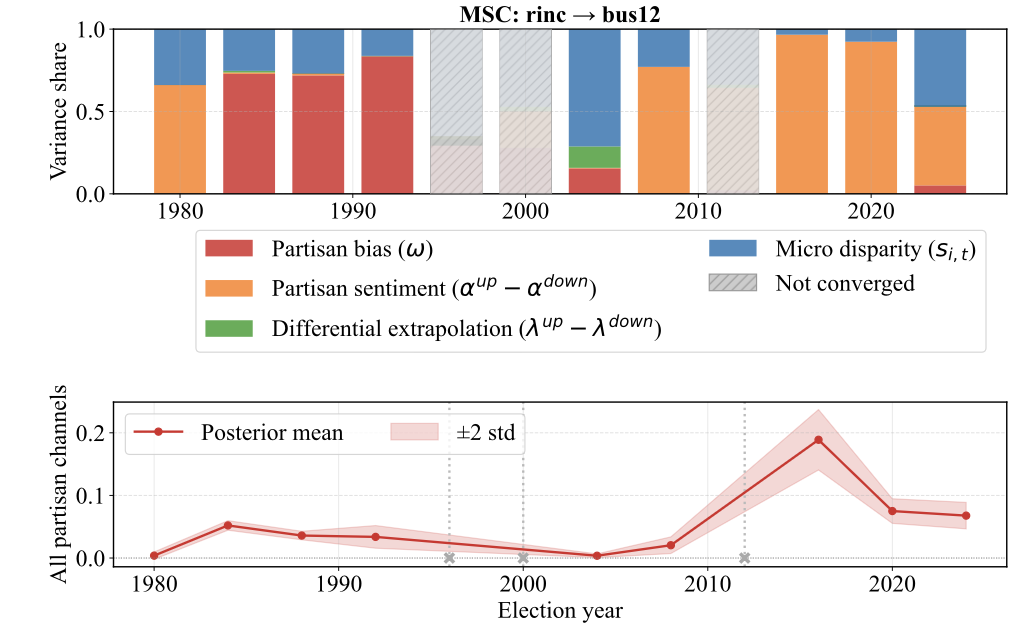
- Households' microeconomic expectations are much less partisan than macro expectations in the survey.
- A belief formation model where households form macro expectations based on heterogeneous microeconomic experiences but distorted by a partisan lens.
- Estimation of the model with specified mislabeled ``types''.
- Partisan macro was not entirely a new phenomenon.
-
Inflation Drivers in Firms' Words: Bridging Micro Narratives and Macro Dynamics [Working Paper][Bib]
(with Chenyu (Sev) Hou and Jiannan (Jay) Jiang )How Do Agents Form Macroeconomic Expectations? Evidence from Inflation Uncertainty[Working Paper][Bib]
Details
- Cross-moment estimates of various workhorse theories of expectation formation.
- Use of high moments such as forecast uncertainty available from density forecast.
- Expectations data contains useful information about inflation dynamics itself.
Publications
Epidemiological Expectations[Working Paper][NBER WP][Jupyter Notebook][Slides][GitHub][Bib]
(in the Handbook of Economic Expectations, with Christopher Carroll)
Details
- A survey of the literature on epidemiological models of how social interactions drive belief and expectations in economics.
- See a recent presentation on this topic
Learning from Friends in a Pandemic: Social Networks and the Macroeconomic Response of Consumption[Working Paper][Slides][GitHub][SSRN][VoxEU][AI Podcast][Bib]
(European Economic Review, with Christos Makridis)
Details
- Evidence for social network as a potential propagation mechanism of aggregate consumption response to the pandemic.
- Counties more socially connected to regions hardly hit by the pandemic saw a bigger drop in consumption.
- Consumption categories that relied upon social contact saw the biggest responses.